
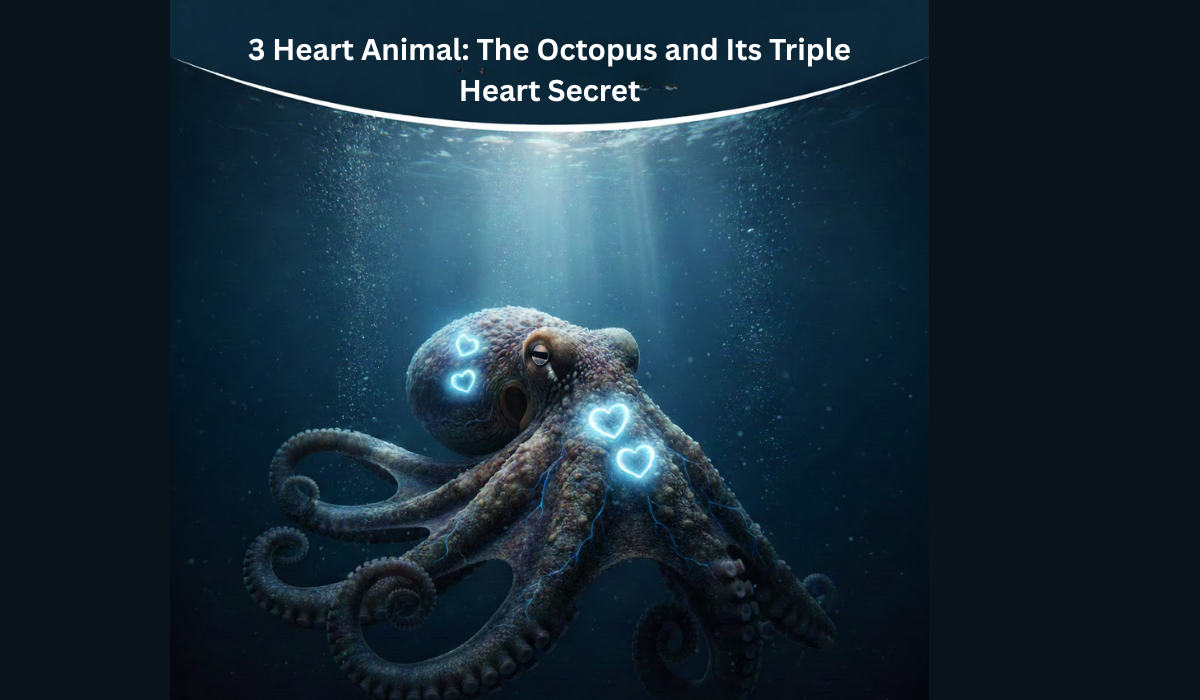
The natural world has many interesting creatures, but hardly any are as fascinating as the 3 hearts creature. The concept of an animal with three hearts sounds like it came from a fantasy world, but it is, in fact, an amazing scientific fact. Knowing the 3 hearts creature shows that evolution can create unexpected biological systems to help the survival of the organisms in different habitats. Here, we explore what makes the 3 hearts creature so different, how its body works, what kind of behavior is associated with such a structure, and why scientists still study it today.
Which animal is the genuine 3 heart animal?
In the case of the 3 heart animal octopus is most commonly implied. As a 3 heart animal the octopus is the most cited one as it has a cardiovascular system featuring three distinct hearts that are functionally one. Two of the hearts are responsible for the gills while the third one circulates the oxygen rich blood to the whole body. Such a structure enables an octopus to live in water environments which can be very different in temperature and oxygen content. There are some other cephalopods with similar systems, but the octopus is still the most referred to.
Anatomy of the 3 heart animal explained in simple terms
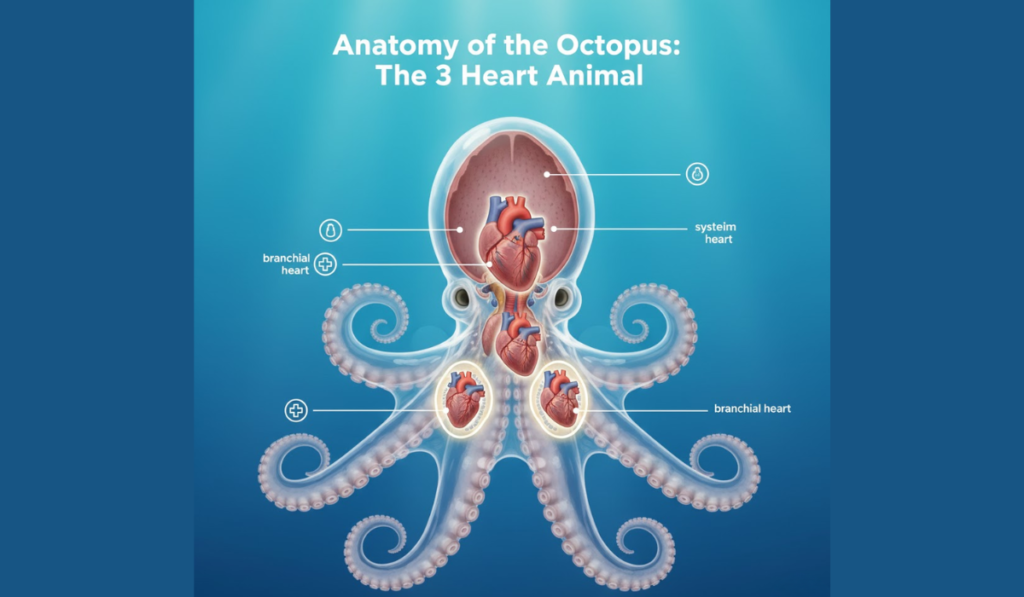
In order to know why an octopus is called a 3 hearted animal, it is useful to know the role of each heart.
Two branchial hearts
These are the hearts that are near the gills. What they do is to pump the oxygen poor blood straight to the gills. Then, the gills get oxygen from the water around them.
One systemic heart
So, the blood which has been turned to be oxygen rich, is sent to the systemic heart. This heart makes sure that the oxygen rich blood is forced to the rest of the body so the muscles and organs that the body is made of, get the energy they need.
They work in harmony and in a constant rhythm, which is the way the three hearts operate. The animal would have a hard time breathing, moving, and hunting if it didn’t have all three functioning correctly. This configuration gives the 3 heart animal a strong circulatory advantage in deep or cold waters where the availability of oxygen can vary.
Why the 3 heart animal evolved such a unique system?
Where the octopus differs so drastically from other animals is in its blood chemistry which is what has led to the evolutionary development of three hearts. The octopus utilizes a copper based protein to carry oxygen instead of an iron based hemoglobin. Copper based blood is very efficient in cold conditions but it needs to be pumped vigorously. This explains why the 3 heart animal system is still able to guarantee oxygen supply even when oxygen levels in the environment are very low. This is a great example from nature of how evolution works.
Behavior patterns linked to the 3 heart animal
Octopuses three hearts are what determine the behavior of this animal. The octopus is a fast swimmer, but it is not its habit to swim; rather it prefers to crawl along the bottom of the sea. When an octopus is swimming fast, the systemic heart is forced to temporarily slow down which results in the animal getting tired quickly. Thus 3 hearts crawling is the best way to save oxygen and keep a steady metabolic rate. This accounts for the fact that most of the time they can be seen moving over rocks, coral, and sand rather than staying in open water for a long time period.
What is more, the 3 Heart Animal has also been widely recognized for being remarkably intelligent. It is capable of solving puzzles, getting out of enclosures, and recognizing patterns. Its incredible brain power requires to be supplied with oxygen and that is why the cardiovascular system still remains very important.
Habitat and lifestyle of the 3 heart animal
Octopuses live in water all over the earth, the abode ranging from shallow reefs to the deep sea. Their soft and pliant bodies along with the acid resistant cups on their tentacles make them perfect for capturing offal like crabs, fish, and mollusks. Being a 3 heart animal they are extremely dependent on water that is rich in oxygen. The question of pollution and oxygen in water. When these two things go downhill octopuses decide to leave the place and find another one with better breathing conditions. Even though their triple heart system is quite strong it still requires the cleanest water sources to be able to live.
Myths and misconceptions about the 3 heart animal
The 3 hearts animal gave rise to many myths. One of the commonly misunderstood facts is that three hearts make the creature almost invincible. To save your life, it is important to know that even in this case, a cardiac arrest will be fatal. Moreover, a fake story goes that an octopus will be able to re grow a new one if the old one is damaged. To be accurate, it can regenerate arms but not the organs of the cardiovascular system. Getting to know these truths makes people avoid misrepresenting the animal.
There are also people who think that every animal living under the water has three hearts. This is not the case. The largest number of the oceanic creatures have only one heart, while the octopus and closely related species are the only ones to have 3 hearts.
Interesting facts that make the 3 heart animal even more fascinating
Here are some unbelievable characteristics of the 3 hearts animal that fascinate people more and more.
● The reason why octopus blood is of blue color is the copper based respiratory protein
● The arms of an octopus have neurons that give them the ability to act separately from the brain
● The creature is equipped with the ability to change color as well as the texture of the skin in no time to hide itself
● A few types of octopus, when chased by predators, can choose to let go of the arm
On top of these, the existence of the three heart circulatory system makes this creature one of the most fascinating beings in the world.
Why scientists continually focus their research on the three hearted creature?
The three hearted creature helps break down the fundamental principles of different life forms which is very important for the progress of biological science. One of the aspects of its cardiovascular function that is of interest to researchers is the way it copes with the inhospitable nature of the surroundings. Such data can indeed pave the way for new inventions in the fields of medicine and engineering. Moreover, scientists are intrigued by the intelligence of cephalopods and want to learn more about it as a possible source of superintelligence that is not found in the mammal branch. Every new revelation gets them more and more wondering how the evolutionary process works and how organisms become more and more adapted.
Interest in 3 heart animal images
As the demand for marine themed education increases, many people look for 3 heart animal images on the internet. Such pictures are very useful for students, teachers, and nature enthusiasts as they allow them to see not only the structure but also the way of life of the octopus. Visuals being a representation of the body, the location of the gills, and the arrangement of the blood vessels are indeed a very effective means of instruction. The 3 heart animal images appeal to the viewer’s sense of wonder and make him more interested in ocean ecology and the necessity for conservation.
Conclusion
The 3 heart animal is perhaps one of the most impressive signatures of evolution in the wild. With the help of its trio of hearts, the octopus manages to accomplish all the life functions such as breathing, moving, thinking, and surviving in the water habitats where other species would not make it. It is indeed the case that from the three hearts to the brilliant mind and subsequently to the camouflaging skills the octopus is the ultimate demonstration of how life adjusts to the new challenges in a very ingenious and unpredictable fashion. Finding out about the 3 heart animal not only enriches one’s interest in marine biology but also, by the same token, makes one more inquisitive about the vast diversity of life that exists on earth.
FAQs
Q.1.Which animal has 3 heart
Most people know an octopus as the one which has three hearts. Out of the three, two hearts help in the oxygenation of blood through gills while one heart makes the oxygenated blood reach the body.
Q.2.Which animal have 3 chambered heart
The ones which have a 3 chambered heart are amphibians and most reptiles. The main difference between the two is that the octopus has three separate hearts whereas amphibians have only one but with three chambers.
Q.3.What is the 3 heart animal name
The most appropriate 3 heart animal name is the one for the octopus. Other cephalopods are more or less similar, but the octopus is the most popular.
Q.4.Why does the 3 heart animal need more than one heart
An octopus has a copper based oxygen carrier in its blood that needs a very strong circulation. With three hearts it can still deliver oxygen quite efficiently even if the water is very cold or has low oxygen content.
Visit also : Fishing Guides Thunderonthegulf | 4th largest island in the philippines